
Several years ago, Wang Zhongxin graduated from the ThD program within the School of Theology. His specialization was history, and he wrote his dissertation under the mentorship of Profs. Dana Robert and Stephen Prothero on “A History of Chinese Churches in Boston, 1876-1994.” Since then, Dr. Wang has been using his amazing breadth and depth of Chinese contacts to establish an academic exchange program between his home country, China, and the United States, where he resides with his wife, Lan Lan, and two young children. Dr. Wang’s long-term goal is a large, well-funded exchange program sending scholars in both directions across the Pacific, increasing knowledge, respect, and mutual understanding between China and the United States.
The School of Theology and Boston University’s graduate programs in religion have enjoyed a long-standing relationship with China. There has been a small but steady flow of Chinese students over the years. But there are other aspects to this relationship, also. Prof. Robert, Truman Collins Professor of World Mission and a walking treasury of our school’s heritage, has passed along several examples of our connections with China.
In our own time, the connections continue. Most obviously, Associate Dean Berthrong is a richly published expert in Chinese Confucianism and often travels to China to support his studies. Former School of Theology Dean Robert Neville was president of the International Society of Chinese Philosophy. One of the stranger contemporary connections is that Dean Neville and Dean Berthrong are the founders of a small movement known as Boston Confucianism. In 2000, Dean Neville published a book called Boston Confucianism: Portable Tradition in the Late-Modern World (among other things, the book argues that traditional Chinese thought offers an important corrective to the excessive individualism of western cultures and a way of thinking about and practically managing cultural pluralism).
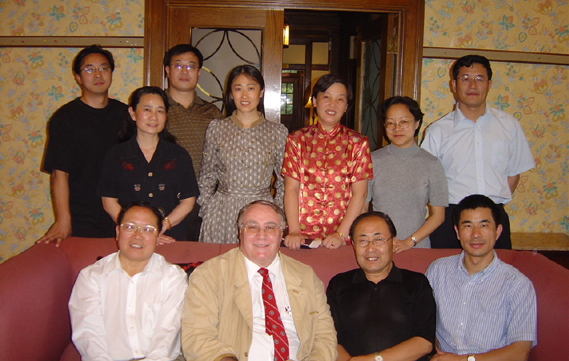
Building on this rich tapestry of connections, Dr. Wang’s exchange program promises a new era in relationships between China and Boston University. Known as the Chinese Christian Scholars Association in North America, Dr. Wang’s program hosts many projects, from translations to conferences to cultural and academic exchanges in both directions. Each summer, Dr. Wang brings a group of Chinese university scholars interested in religion to Boston and recruits local experts to provide lectures on cutting edge topics as a basis for conversation with these visitors. Dr. Wang also takes North American scholars on lecture tours to China.
This essay reflects on my recent lecture tour in China with Dr. Wang’s exchange program. My aim here includes celebrating one of our School’s alumni, of course. But my primary interest is to convey to other STH alums something of the amazing cultural transformation underway in China and how that is affecting religious thought and the Chinese Christian churches.
What was this trip about? Basically, science and religion. But science and religion is not an abstract theoretical issue in China (or anywhere). It is just about the most fundamental cultural issue that Chinese intellectuals face, for reasons that I hope to describe. So the purpose of the lecture tour was primarily to present Chinese university faculty and graduate students with cutting-edge interpretations of religion and of science in which conflict between them takes a back seat to cooperation, thereby reducing pervasive and dangerous misunderstandings. Why me? A happy coincidence. The John Templeton Foundation recommended me to Dr. Wang and Dr. Wang already knew me from my involvement in his Summer Institute, which brings Chinese scholars to Boston. In this way I became the target of the secondary aim of Dr. Wang’s exchange program: to educate a western scholar about China.
To appreciate some basics about the trip, here are a few key numbers. 20,000+ miles by air, rail, and car over 16 days; 6 cities, 7 universities, 9 lectures and 2 panel discussions; 27 banquets with university dignitaries and a miraculously low 4 added pounds; temperatures down to -40 degrees windchill (I always wanted to experience the temperature at which the Fahrenheit and Celcius scales agree, but I have no desire to do it again); 100 new friends, 10 new friends whose names I can remember, and 1 extra suitcase to lug home gifts; several new Christians and uncountable seeds planted of both the intellectual and spiritual kind; 1 exhausted and mind-boggled professor glad to see his wife and kids again.
The main part of my report consists of twelve vignettes, one for each of the original disciples of Jesus, and one for each year in the Chinese calendar cycle. Each illuminates an aspect of Chinese culture and its fascination with science and with religion.
Embracement: We are walking around Shanghai guided by a friend of Dr. Wang, a professor and an expert in local history and architecture. I think I hear the numbers right: 200 new skyscrapers in the last ten years. The old city meets the new city in spectacular fashion along the river winding through Shanghai. On one side stand old British and French-style buildings with previously covered-over art and decorations restored to magnificent glory. Across the river looms a space-age skyline, entire buildings turned into television screens, amazing lighting, shining glass. The Chinese are fascinated by science and technology. These are the gateways to modernization, which they seek with furious determination and energy. Billboards proclaiming “Embracement” dot the landscape, when you can see them through the polluted air: “embrace modern life” is the message everywhere.
Promise of Modernity: We are visiting the Nanjing Massacre Memorial, which recalls through astonishing sculpture and documents the torture, rape, and murder of Chinese around Nanjing during World War II—300,000 killed, often in deliberately brutal fashion, with some Japanese army officers competing for the largest numbers. The closing plate in the museum reads (in paraphrase): “We must never forget how a backwards and undeveloped nation can be humiliated at the hands of an aggressive enemy. We must reach deeply into our courage and resourcefulness and change our society so that this can never happen again.” For the Chinese, embracement of modernity is a national imperative, a means of honor, the key to prosperity, security, and dignity.
Chinese Philosophy of Science and Technology: At Harbin Institute of Technology, China’s MIT, we are in a beat-up seminar room packed with people, being presented with plaques celebrating the 2004 launch of an experimental science satellite developed there, and listening to the history of the institution being proudly recounted. I am being led to understand that philosophy in China means not history of Chinese philosophical classics or logical analysis of arguments, which some characterized bluntly as boring, but creative thinking about the future of science and technology, in which scholars seek to understand all of reality, Chinese society, and their own lives in terms of the new possibilities that science and technology make available.
A New View of Religion: Here is a summary of a key transition in an early lecture at Harbin Normal University. “Religious studies shows us that Marx was only partly right about religion being a symptom of social ills, and this is why he was quite wrong in his prediction that religion would wither away once social and economic transformation removed the conditions that perpetuate suffering and misery. With the benefit of religious studies, however, Marx might well have distinguished between aspects of religion that are linked to deprivation and other aspects of religion that would persist even in perfect social conditions, and thus he might have accepted religion as an ambiguous ally in revolutionary social change. Thus, religion is inevitable, just as human curiosity makes science inevitable, so we had better make sure that we understand how the two can coexist and cooperate.” An extremely energetic discussion ensues, with key professors confessing that they have been coming to the conclusion that they and China itself has made a vast error in its understanding of religion and saying that they need to find a completely new attitude and approach to religion.
Fearful Memories of a Painful Past: Same city, next day: Paul Chien is the other regular lecturer on this tour. He is an older scholar with long memories, a Christian biologist from the University of San Francisco who became a US citizen after having suffered the experience of nationlessness common to people born in Hong Kong. Dr. Chien shared his feelings about the current generation of students and young scholars. With tears in his eyes, he explained his fear that their frank admission of a vast error in the Chinese official and scholarly attitudes to religion could lead to renewed persecution, despite the “freedom of religion” clause in the constitution, and despite the current fresh air policy toward religion, which includes Government investment in university religious studies. This is a deeply moving and disturbing moment. Is the painful past really past?
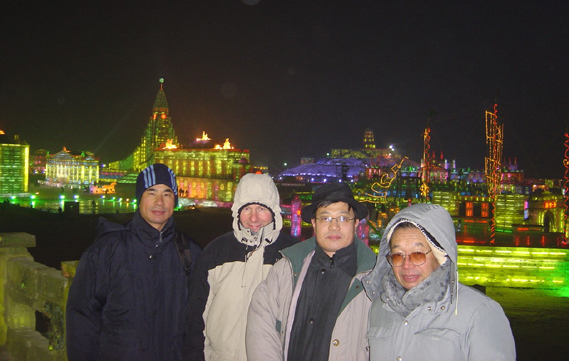
Professional Interest in Religion Meets Personal Curiosity: We are somewhere between Siberia and the North Korean border, on a six-hour car trip to Asia’s largest ski resort for the day. After skidding along icy roads in incredibly cold weather, passing many accidents, we stop at a tiny hole-in-the-wall café and huddle over dog soup for breakfast with my traveling companions and two non-Christian professors of philosophy. Before we can eat, however, the two Chinese professors insist that I say a shared grace before the meal, which is what Christians are supposed to do. So I pray a hybrid Christian-Confucian style of prayer, which is translated for the table, and we dig into the dog. I have shared meals with many non-Christian professors of philosophy but I have never been asked to pray over the meal before eating. Maybe they were doing religious studies field work. Later that day, returning along the same icy roads after much fun and laughter in the most brutal cold, my companions capable of translating fall asleep in the back of the van, and my two non-Christian professor friends ask in very broken English that I teach them some Christian songs. So I teach them Amazing Grace—first the words, and then the tune in tiny segments, until after fifteen minutes we can sing one verse through reasonably well. Next was “Jesus Loves Me This I Know, For the Bible Tells Me So,” which I teach them in similar fashion, with the two Chinese philosophers booming out “Yes, Jesus Loves Me” at the top of their voices. We also covered “Ten Green Bottles Hanging on the Wall” and “Auld Lang Syne,” which is the most popular ring option on Chinese cell phones. But their favorites are Amazing Grace and Jesus Loves Me, and they keep demanding to sing them over and over. Even among Chinese intellectuals, the interest in religion is not just about China’s future. It is part of an existential quest for a way to comprehend the meaning and purpose and value of their lives.
The Land of Santa Claus: everywhere you look you see Santa Claus pictures and Christmas decorations, on shop windows, in restaurants and homes, in public places. Christmas in China is completely secular, with no relation to the religious meaning of Christmas. It is entirely to do with end-of-year and new year celebrations, and signifies a week of partying from Christmas eve when Santa comes on his sleigh bringing gifts for the children through to the western New Year—and the decorations stay up until the Chinese New Year. Santa always looks Western and the holiday atmosphere is understood as taking over one of the best western ideas ever and making it Chinese. On New Year’s eve, after viewing the astonishing and world famous Harbin International Snow and Ice Festival, and the New Year fireworks, we go on a church tour. We see a Catholic, a Protestant, and an Orthodox church that evening. The Orthodox church is close to the center of Harbin’s entertainment district and it is decorated big time and playing recorded music from its steeple. What music? Alvin and the Chipmunks and the Smurfs singing exclusively non-religious Christmas tunes.
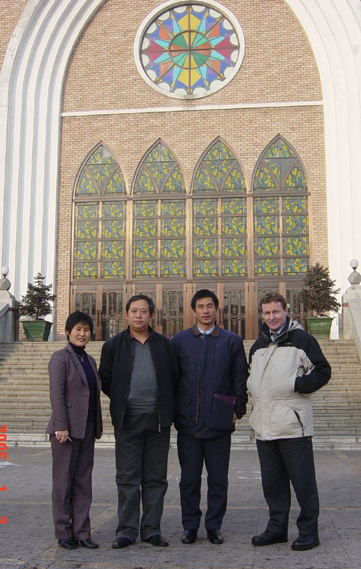
Fledgling Seminary Education: We are visiting a vast church to meet with the ministerial team (in most of China there are just Christian, Catholic, or Orthodox churches, with the Protestants snagging the “Christian” title; this was a “Christian” or Protestant church). The place could hold about 2,500 worshippers and is packed for multiple services each week. The head minister is also something like the “bishop” for the area, except that he is not a bishop. In fact, Chinese polity in this area sounds more like pre-bishop Christianity, with churches clustering together for communication and survival. Our normally noisy non-Christian friends are strangely quiet inside the church. Thinking back to the car trip I play amazing grace on the piano and give them a broad smile. The minister seems quite cool until he discovers that I am a Protestant pastor. Then we have a lively translated conversation about seminary education, which is just getting organized in this part of China. They put their seminary students through two years of courses in basic bible (no original languages), history (of world Christianity, of course), and ethics and pastoral skills. I note with chagrin that they do no meaningful theology or philosophy. Then they spend one year learning on the job in a field placement setting, then two years of church work as a “teacher,” and then finally becoming a “pastor.” The churches are extremely conservative because of the style of seminary education. The seminaries struggle but do not have to operate secretly. It was moving to get a glimpse of the church trying to organize itself.
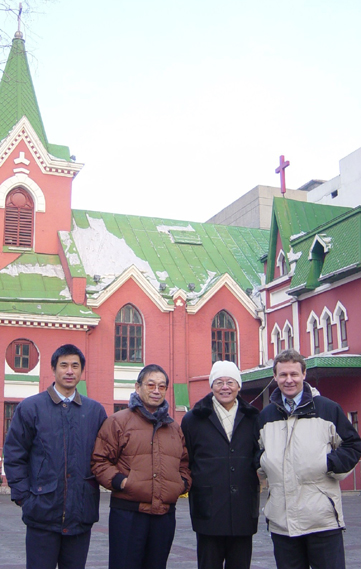
Enculturation: One of the great old scholars of Harbin, the revered Prof. Sun, is a Christian and the son of a Presbyterian Minister. He has close-to-the-surface, emotional memories of long-standing persecution for being Christians, a lower class of person in China. Prof. Sun takes us to his father’s old church, once a Lutheran Church but now a “Christian” Church. We go inside the beat-up old building, which holds about 150 people—the opposite of the vast church we had seen earlier. Painted on the main wall of the Sanctuary for everyone to see is Santa Claus riding on a sleigh. I ask what the large Chinese characters above the painting mean. The answer is “Emmanuel,” or “God with us.” I am overcome with admiration for this vision of Chinese-Christian enculturation at work. I had pictured enculturation with Confucian or Daoist or Buddhist symbols and ideas but not with an utterly secular Western import. Such is the popularity of Santa Claus in China that this church uses the jolly old man arriving in a sleigh on Christmas eve to explain what God coming to us in Christ means. In our churches we just mention Santa Claus in children’s talks to hook the kids before talking about Jesus. Here Santa Claus is the key to understanding Advent.
Institutional Creativity: I wonder how effective the whole Santa Claus approach is, given how beat up and small this little church was. As we walk outside I see people pointing at an apartment building next to the church and ask what they are saying. It turns out that the beat-up old church bought that eight-story apartment building, knocked down the interior walls on each floor, and stuffed it full of closed-circuit television equipment. Now it transmits the worship service in the old church to 3,000 people at a time packed into the apartment building.
Unexpected Conversions: In one lecture event, after an extremely intense discussion, of which I grasped only a fraction, one young woman stood up and testified that she was a Christian and spoke from her own experience of what religion can mean to a person—which in some ways is the great question in China. When religion has been so marginalized and despised, what could it mean for a Chinese person to embrace religion? She showed courage to speak in public this way, especially in front of her professors; it is extremely unusual in China. Shortly after that, a young man stood up and explained that our lectures of the night before had led him to speak long into the night with friends and become a Christian. This was his first confession of that fact to his world—another act of courage. At this point in the trip I understand quite well why religion is so powerful in China but I need to understand why Christianity is so attractive. The lectures were not about Christianity, after all; they were about religion. Over the banquet lunch that follows I learn that the importance of Christianity is pretty much a process of elimination. Buddhism and Daoism represent retreat from the world. Confucianism is grandfather’s poisonous oppression. Hinduism and Judaism are culturally alien. Islam is anti-modern and Islamic struggles with modernity represent exactly the direction China does not want to go. Christianity is the religion of modernity, the religion in whose womb modern science and modern life grew, and the religion that is flourishing in China. It is an irony: the greatest social force promoting Christianity in China is the government’s impressive drive toward modernization.
Racial and Sexual Politics: Everywhere I go, the lecture halls and seminar rooms are filled with women studying philosophy and sociology of science and technology—always significantly more women than men. But the professorial panels and the banquet meals with university officials are filled with men—rarely even one woman at the table. I repeatedly ask about this contrast and am never satisfied with the evasive or unintelligible answers I receive. The most honest answer is the interpretation of a Beijing graduate student that women are better at organizing their studies, which is why they thrive in large numbers at the undergraduate and graduate levels, but that men have better ideas and are more creative, which is why they dominate professorial and administrative posts. I accept his answer with amazement, wondering how many people could possibly believe this transparent rationalization for male privilege in universities. Also, everywhere I go I am like a beacon in the night, or perhaps an obvious dent on a shiny new car. Chinese people I had never met want to take photos with me because of my odd appearance. Numberless street hawkers believe I want to buy fake Rolexes. Strangers want to practice their English with me. Eventually I get to the point of answering English inquiries in German just so that I can politely extract myself and keep moving with my friends. I am not on the wrong end of racism in any of these experiences, of course; it is more like being an anonymous celebrity. But I have rarely experienced being responded to exclusively because of my skin color, the paleness of which is extremely rare in China. Even in India, it is the fact that I am a cricket-loving Australian that locals pay attention to more than my light-pinkish-grey skin tone. China has many small racial minorities but is highly racially uniform by Indian or Western standards.
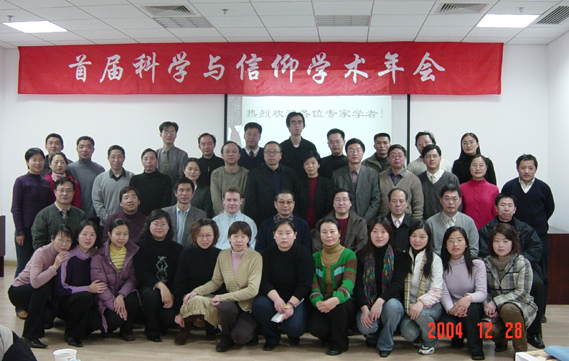
In concluding this report, I pose an invitation to our alums. Is there any way you can help to enhance Dr. Wang’s exchange program and its relationship to Boston University’s School of Theology? The School’s administrative staff and Deans already do a great deal through sponsoring Chinese travelers to the USA and by lending the university’s reputation to Dr. Wang’s efforts. Our faculty pays close attention to applications from Chinese people wanting to study here, which Dr. Wang’s program is increasingly producing. But an exchange program is as costly as it is valuable. The price tag is $20,000 for bringing six Chinese scholars to Boston to study religion in Dr. Wang’s Summer Institute. It costs $11,000 to sponsor a visiting professor from China to do research in Christianity at Boston University for six months each year, and $4,000 to support one STH professor to go on a lecture tour of the sort I just did. Currently Dr. Wang has to raise this money and run his exchange program from out of his home in Newton, MA, so some free office space would make a huge difference to him and his family. If you know of people with a love for Christianity and China who might be willing to help fund Dr. Wang’s exchange program, or if there is a local church mission program with this kind of interest, then please forward the information to our Director of Development, Steve Morin, in the School of Theology.
The wider story here is our school’s heritage of training the seminary professoriate in parts of the world where Christianity is new or growing. This has been extremely important in the past, especially in Korea and Africa, but also in China, as Prof. Robert’s examples demonstrate. This educational mission work will continue to be important in the future—and, thanks to Dr. Wang, increasingly important in China.

- End -